An Ashland animal communicator recalls spending time with the famed primatologist and humanitarian
By Barbara Shor
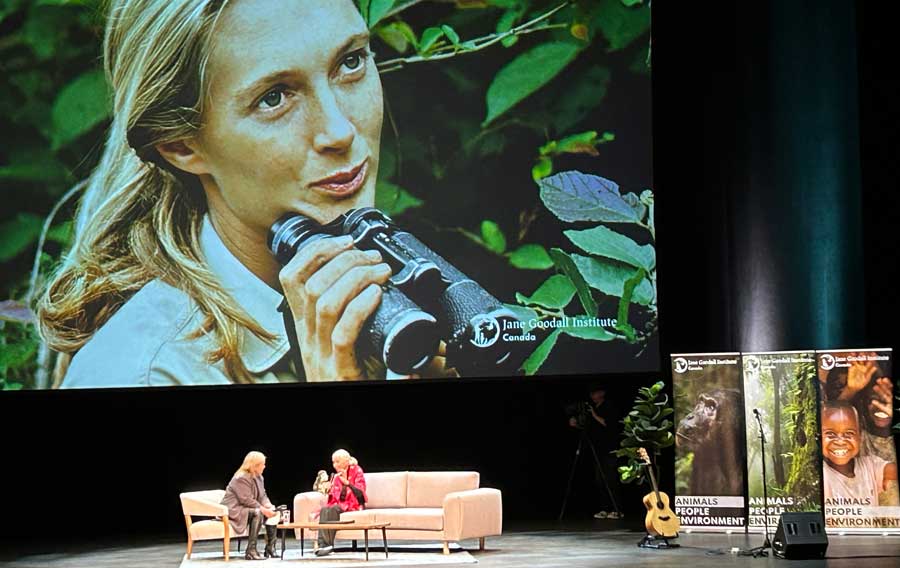
Last year I attended a celebration of Dr. Jane Goodall’s 90th birthday in Vancouver, British Columbia. Jane spoke for two hours, as eloquently as ever. I left inspired and amazed at this incredible woman, who still traveled 300 days a year.
Twenty years ago, I had the rare privilege of spending time with Jane at the Aspen Ideas Festival, as her volunteer liaison. She worked endlessly, signing books for as long as it took, sometimes up to four hours. And she continued working late at night and from early in the morning.
What touched me most? Jane’s deep connection to animals and the natural world, and her strong dedication to the conservation and protection of the ones she loved so dearly. A man asked her what caused her to be so calm, confident, and committed. With deep reverence, she spoke about the peace of the forest. She said that all she needed to do was close her eyes and she was there. She carried it with her.
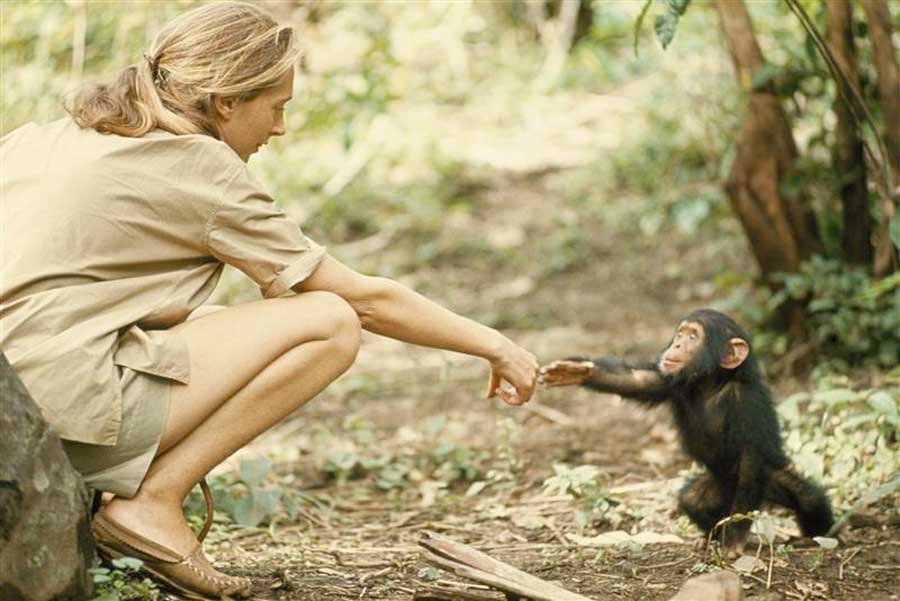
Jane said that Dr. Dolittle was a huge influence in her life, and that her childhood friends often told her she could talk to animals. She said that even though she wanted to, she knew she couldn’t. Here is where I beg to differ. I believe that Jane did talk to animals — not through words, perhaps — but through her deep love and appreciation for them, as well as through her dedication to their welfare and well-being.
I first met Jane Goodall in 1987 at a lecture she gave at the Sacramento Zoo, where I was working as veterinarian as part of my residency program in non-domestic animal medicine at UC Davis.
I was so excited to meet my hero! After waiting in line to have a book signed by her, I told her that I had been to Africa and wanted to go back, and that I had just spent some time at the UC Davis Primate Center and had also worked with chimps at the zoo.
I thought she would tell me how great I was, commend me for all the hard work I had done in my career, and encourage me to go back to Africa. Instead she told me that veterinarians were among the worst offenders in terms of animal abuse and exploitation because, although they are often in positions of power, they put up with the cruelty that goes on in the animal world without speaking out or changing things.
At first I was devastated, and then I got mad. “Who is she to tell me these things? What right does she have to judge veterinarians?”
So the next night I went back. Jane was again signing books after a private dinner put on by the zoo. When I met with her this time, I told her that she was wrong, that not all veterinarians are insensitive, that some of us really care. She apologized and said that perhaps she had generalized too much and was a bit too harsh.
Now, years later, I see how naïve I was back then, how accepting of the status quo without questioning it, and how afraid I was to speak up. I wasn’t willing to experience my own feelings or to honestly look at what was being done to the animals. I didn’t have the courage or openness to look at the truth. The truth was that there were abominable horrors going on in the name of science and I wasn’t able to acknowledge the reality of the situation at that time. Jane helped open my eyes and my heart.
Since that time, my career has taken a 180-degree turn. I left veterinary medicine and became an animal communicator, which means speaking telepathically to animals. It is heart-based rather than mind-based profession.
And so, after this long and exciting journey I’ve taken with animals, it is clear to me that animals do talk and that we can communicate with them. Dr. Goodall was not so far from Dr. Doolittle as she may have thought.
The above is an excerpt from an article written by Ashland resident, animal communicator and veterinarian Barbara Shor in 2005. To read the full article, click here. Jane Goodall died Oct. 1 at the age of 91. Contact Shor through her website, barbarashor.com.