Facilities studies recommend moving most municipal operations to 90 North Mountain Ave., potentially selling downtown properties to fund long-term upgrades; officials also mull municipal bond to fund infrastructure
By Steve Mitchell, Ashland.news
The Ashland City Council mulled whether to consolidate city services into a single civic campus, such as at 90 North Mountain, or keep municipal operations in the city’s downtown core during a Wednesday, Jan. 14, special study session.
The discussion came on the heels of a presentation on Ashland’s facilities master plan and a comprehensive facility condition assessment, which found that many of the city’s core buildings, including the airport terminal, City Hall, and Briscoe Elementary School, require significant improvements.
Public Works Director Scott Fleury walked the council through a rundown of two studies — the facilities master plan and a comprehensive facility condition assessment — completed by ORW Architecture and its subconsultant, McKinstry. The council commissioned the reports in early 2024.
Fleury said the vision of the conditions assessment and master plan is to “create good, high-functioning facilities that provide services to the residents that they need in the appropriate location.”
What came out of those discussions with ORW was the recommendation that the city establish an “Ashland Civic Campus” to consolidate most city services at a single location.
Currently, the city’s services are spread across nearly a dozen locations, according to meeting documents.
Consolidating city operations into one single campus — such as 90 North Mountain or Briscoe Elementary School — would allow the city to cut costs, improve operational efficiency, and require fewer vehicles and support staff.
ORW recommends relocating services to 90 North Mountain Ave., Ashland’s current public works service center.
The location, the study says, would be cost-efficient, support future growth, and free up downtown sites, including City Hall and the community development center, according to the meeting documents.
Fleury added that the 90 North Mountain Ave. option would include “divestment” of Briscoe Elementary School, with the proceeds used to complete the project. Overall, he said the project would involve 20 phases, including the creation of temporary offices to house city offices for the duration of the multi-year project.
The phases would “nuance and change” as the city moves through the project, he said.
“Honestly, you’re talking five to 10 years potentially, to get through each one of these activities,” Fleury said.
For instance, he said, 90 North Mountain would require reconfiguring existing structures, relocating some and then building others.
He said the true cost of either option is unknown, but the Briscoe Elementary School option would likely be the more expensive option due to the significant structural work and elevated parking needed for the site.
Financial realities
With 90 city-owned buildings and park facilities requiring over $70 million to replace major equipment and bring them into compliance, the city cannot afford to act, according to Mayor Tonya Graham.
“We have a large number of buildings. We haven’t really looked at them strategically for a long time. They’re in desperate need of some significant work,” she said.
The dilemma raises the question of what the city can pay for with its current resources and what makes the most sense for Ashland’s long-term investment, Graham said.
She said that communities pay for major infrastructure through municipal bonds. At some point, the city will have to put a bond out to voters.
“It’s how you pay for things that are much larger than what you can manage in your current budget, and you pay them back over time,” she said.
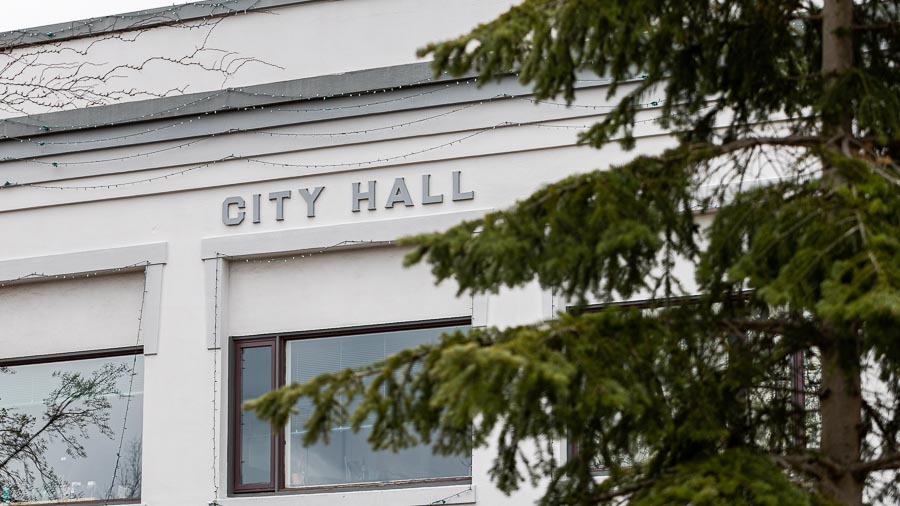
Graham said voters rejected a 2020 bond measure to pay to rebuild Ashland City Hall. City Hall houses city administrators and is open a couple of hours of week. According to the condition assessment, the facility needs major upgrades, including a new roof, heating and air conditioning system, and parking lot improvements, among others.
City Hall is among the properties the ORW recommends the city sell or lease for commercial use to bolster economic activity in the downtown corridor, along with the Community Development building near Lithia Park.
Graham and Councilor Gina DuQuene expressed concerns about moving city services — especially City Hall — out of downtown and potentially leaving landmark buildings, such as City Hall, empty.
The city also has yet to resolve its clouded title to the City Hall property. According to a study session staff report in October: “The Ashland City Hall at 20 East Main Street is owned by the City of Ashland but is subject to restrictions from an 1884 deed from John R. Helman and Mary Helman. The deed contains a reversionary clause: if City Hall and its adjoining Plaza are not used as a public square, jail, and town hall, rights may revert to the Helman heirs.”
Separately, Graham said the city should question the economic development assumptions made in the master plan.
Neither the community development building nor the City Hall has parking, she added.
“Are we having businesses clamoring to get into downtown right now? I don’t know that we do,” Graham said.
Deputy City Manager Jordyn Rooklyn said the city has a lot of prime downtown square footage that is not accessible to the public. She said divestment does not necessarily mean sell, but it does mean “divest” out of city use so that other uses can come in.
For her part, DuQuene said she would like City Hall to reopen.
“So many people miss downtown not being able to go and talk to the mayor, the city manager, or go pay a utility bill or ask a question,” she said.
DuQuene said Ashland residents need to have a voice in the process before the city moves forward with a sale or lease of a city-owned facility.
Councilor Jeff Dahle said the city needs to be transparent in calculating the cost of the options and including the cost of doing nothing.
“It is so incredibly important that we clearly articulate the costs of doing nothing and what it takes to maintain the current buildings,” he said.
He added that there is a difference between the city doing nothing and saying they’re going to do something, only to be delayed.
“They’re similar, but different,” he said. “And each one has its own costs.”
Email Ashland.news associate editor Steve Mitchell at stevem@ashland.news.