Council eyes partial sale of Imperatrice property and enters negotiations to sell 380 Clay St.
By Steve Mitchell, Ashland.news
The Ashland City Council on Tuesday, Dec. 2, moved forward on repurposing two city-owned properties — the 846-acre hillside grassland known as the Imperatrice property and 380 Clay St. — as part of the city’s broader efforts to generate revenue as it faces a looming financial cliff.
Imperatrice property
The Ashland City Council on Tuesday, Dec. 2, took steps to repurpose nearly 900 acres of city-owned land, known as the city’s Imperatrice property.
The council voted unanimously to direct city staff to enter into a “surplus process,” which could include partitioning and selling the lower portion of the property, while retaining the upper portion for possible conservation, and perhaps trail use.
The sale of the land, according to city officials, would allow Ashland to reinvest in the city’s wastewater fund and potentially offset or reduce future rate increases.
Originally purchased in 1996 for the city’s wastewater treatment plant, the hillside grassland mostly east of Butler Creek Road and west of North Mountain Drive on the northeast side of Interstate 5 interchange is valued at $3.8 million, according to Public Works Director Scott Fleury. City documents note that the city purchased the land for $954,000.
Fleury said the land is no longer needed for the wastewater treatment plant, which leaves the 846-acre land parcel as surplus. Over the years, he said, the land has been leased for cattle grazing and considered for other uses, including ecological restoration and, at one point, a solar facility.
Fleury said Tuesday that sale of surplus public property in Oregon requires a “specific and onerous process.” He said the city must issue a public notice ahead of a hearing about the surplus process. The notice must include a description of the property, the city’s case for selling the property, appraisal information, and how the city intends to sell the land.
Fleury said city staff have internally discussed partitioning off and selling the lower portion of the land, which was appraised at $2.4 million in 2024. Fluery said the lower portion encompasses about 300 acres, which the city could potentially sell. He said the city could maintain ownership of the upper portion, which is valued at $1.4 million.
He said the city has been in conversations with the Southern Oregon Land Conservancy to potentially manage the upper section of the land, above a Talent Irrigation District ditch.
Another scenario officials are exploring, Fleury said, is a land swap with property managed by Ashland’s Parks & Recreation Department. Fleury said there is park-managed land adjacent to the wastewater treatment facility that was purchased with state conservation funds, which put restrictions on the property. A land swap could open up opportunities for both development and environmental protection, Fleury said.
Fluery said Rocky Houston, the city’s parks director, is working with the state to see if the restrictions still exist, given that the city purchased the land near the wastewater treatment plant nearly two decades ago as part of an expansion of the Bear Creek Greenway. It’s unclear if those restrictions are still in effect, Fleury said.
Ashland City Councilor Gina DuQuenne said having the Southern Oregon Land Conservancy manage the upper portion of the parcel would be beneficial. However, she said, the sale of the lower portion could alleviate the financial headwinds the city and ratepayers are facing. She said the council’s retreat on Monday underscored the dire budget situation the city faces.
380 Clay St.
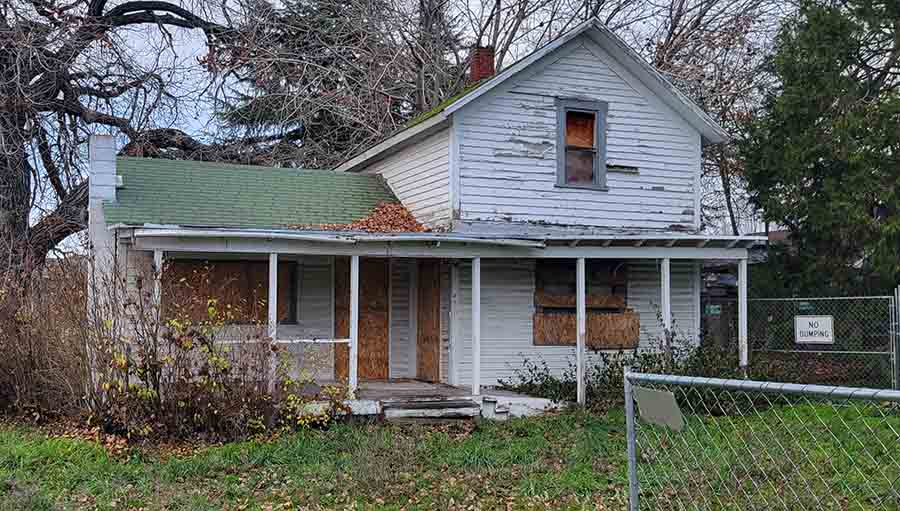
The council also unanimously approved moving forward with negotiations of the potential sale of 380 Clay St., a 14,000-square-foot city-owned property that was recently appraised at $250,000.
The property includes a deteriorated single-family home and a large Fremont cottonwood tree that takes up a significant portion of the property, limiting the number of units that could be built on the property, according to Deputy City Manager Jordan Rooklyn.
She said the city has twice been denied permits to remove the tree.
Community Development Director Brandon Goldman said there have been competing evaluations from arborists about whether to remove the tree. One said that it should be preserved, he said, and another has said it is dangerous and should be removed.

Nonetheless, Goldman said the tree has been marked for protection. An applicant who intends to build at 380 Clay St. would need to provide an arborist’s recommendation on minimum protections for the tree.
According to Rooklyn, Allan Sandler, a local developer, has offered to purchase the property to develop housing. She said Sandler has offered to pay cash for the property at “close” to the appraised price. She said Sandler is open to purchasing the property at a lower price in exchange for restricting the development to designated price-point housing.
Rooklyn said that since the property was originally purchased with general fund dollars, it could go back to that fund or a different one since it would not have any specific restrictions about where it should go.
Sabrina Cotta, Ashland city manager, said that the council should consider putting the money into the city’s facilities fund. She said there is no money in the general fund for facilities.
“If an HVAC goes down, or anything like that,” she said, “it’s coming out of contingency at this point.”
The council did not take an action as to where any proceeds from the sale would go.
Councilor Bob Kaplan said the city could decide on that later.
While the council considered a deed restriction that would require only affordable housing to be built on the property, officials agreed that it could slow the process of creating more housing. Such projects can take up to three years.
“This is the best, most expeditious thing for this particular property,” Councilor Eric Hanson said.
Email Ashland.news associate editor Steve Mitchell at stevem@ashland.news.