Council looks at long-range view during five-hour retreat, starts lining up options for three budget cycles starting with 2027-28
By Damian Mann for Ashland.news
A potentially dire budget cliff prompted the Ashland City Council Monday to look at possible future cuts to police, fire, the City Band and burial services, along with various ideas to increase revenues.
The council held a five-hour “retreat” in its council chamber Monday to hash out ways to avoid expected budget shortfalls over the next three bienniums that ranged from just over $1 million in a best-case scenario to more than $23 million in a worst-case scenario.
At the same time, councilors, who spoke more informally than during a business meeting or study session, said they want to consider increasing a contingency fund that is currently about $2 million to possibly up to $9 million.
The city currently has enough reserves on hand to keep the doors open for a few weeks. A larger contingency would last about two to three months, similar to the reserves in Central Point but less than the one year of reserves held by Jackson County.
“If we have a catastrophic event, we can operate only a few weeks,” City Manager Sabrina Cotta said.
Building up this reserve account over two or three biennial budget cycles would further impact the city’s picture.
“What that means in reality is a reduction somewhere else,” Cotta said.
Councilors indicated they wanted to look at the possibility of creating a reserve account, but Councilor Derek Sherell asked, “Where does the money come from?”
Councilor Eric Hansen said he understands the current city reserve is not a lot, but said, “It doesn’t scare me to move into a biennium with what we have.”
Mayor Tonya Graham said it seemed unlikely that the city could find itself in a position where no money was coming in, but she said the risk of catastrophic events is going up and the city needs to put itself in a more self-sufficient position.
“Having a bigger reserve than we have now is good,” she said.
Graham pointed out that the city went through a “perfect storm” in the past few years as the country came out of pandemic, and the city had understaffed departments as well as federal and state dollars drying up.
Cotta told the council that a bigger reserve could impact child care grants and sister cities relationships as an example of potential cuts.
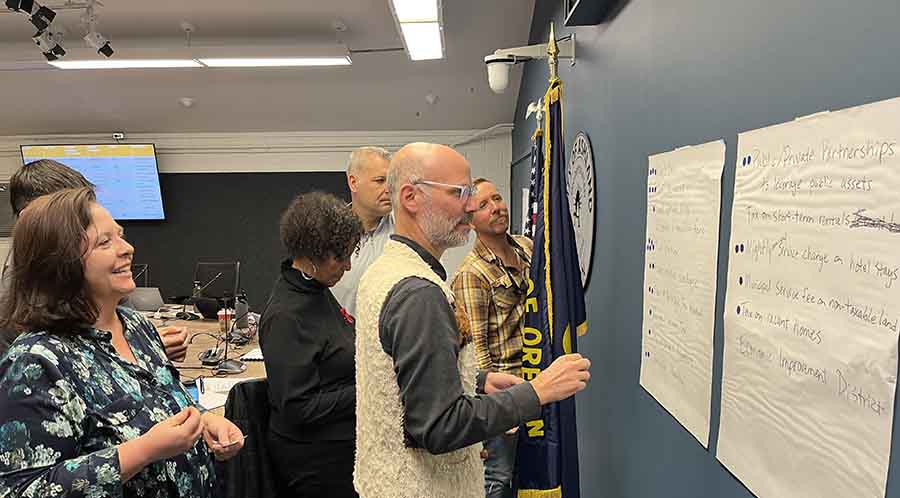
The council created a list of 10 possible areas to cut to deal with looming structural deficits that could be affected by economic forces, disasters or uncertainty about federal and state funding sources.
Of these, the ones that received at least four “votes” from councilors include extending the life of fleet vehicles, outsourcing human resources, recovering more costs for burial services, using city staff to support ad hoc committees and staff reductions in police and fire.
A total of 15 possibilities for taxes, levies and fees was also considered.

Those that got at least “four” votes include a local fuel tax, a local option levy, paid parking in the downtown, an event ticket surcharge, a redevelopment district, a housing project partnership with a developer, a nightly service charge on hotel stays, a municipal service on non-taxable land such as churches, and seeking voter approval for a permanent Food and Beverage tax, with 10% earmarked for infrastructure projects.
Armed with these suggestions, city officials will craft a proposal next year.
Cotta told the council that she’d like to hold public meetings and to have a better idea where to make cuts earlier rather than later, possibly wrapping them up by mid-September. She said this would give staff the ability to prepare the recommended 2027-2028 biennial budget. Cotta pointed out the current almost-$45 million general fund budget is balanced.
Councilor Dylan Bloom said it was problematic to ask voters what they wanted from the city if it was going to be making cuts, “so they’re not fooled, or let down or lied to.”
Cotta said the public could help decide what areas of the city would be appropriate to cut and what would not be.
She said it’s important to set up these public meeting sooner rather than later.
“I want decisions made no later than September,” she said.
Cotta said her staff would likely recommend only a few areas to make cuts, but these areas would likely produce the most impact on alleviating future budget deficits.
“You need to think about whole programs that need to be removed,” she said. “We kind of need to galvanize in what we’re going to do.”
Councilors indicated they wanted Cotta to come back with a proposal for cuts that indicates how much it will impact future budgets.
Cotta said the council would have to look at staffing levels in departments, such as having one supervisor for a larger number of employees.

The city is already reviewing each job opening to determine if the position is necessary for operations, with some recent software changes and other technology.
Bryn Morrison, interim city finance manager, presented a series of spreadsheets to the council showing how the best- and worst-case scenarios were developed.
The city relies on a number of revenue sources for its general fund budget, with the two largest being taxes and service fees.
These revenue sources fluctuate depending on the economy and other factors, Morrison said.
She said the worst-case scenario would see less revenue than normally expected, such as a sharp reduction in the collection of property taxes.
“It does not look good,” she said.
Councilor Bob Kaplan said, “Isn’t there a worse-worse case scenario?”
Morrison responded that during the 2008 recession the property tax collection rate was 92% while it generally runs about 97% or higher. She said these historical factors played into the modeling for the worst-case scenario.
Morrison said the finance department has already cut one manager position, but said her department urgently needs another accountant to help handle the volume of work.
At a future joint meeting the Ashland Parks & Recreation Commission, the council plans to have similar discussions about cuts to Ashland Parks.
Reach freelance reporter Damian Mann at [email protected].