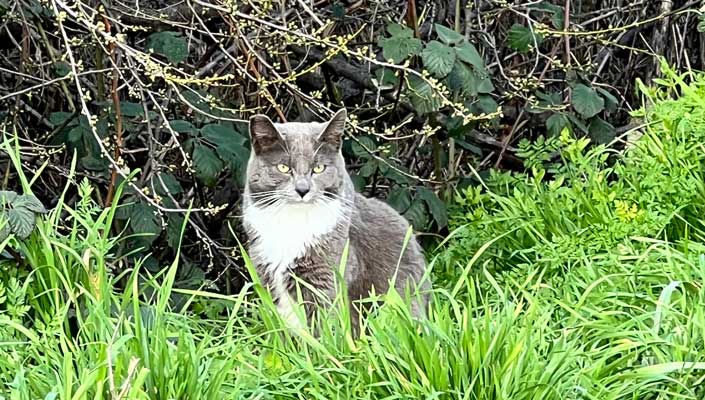
Learn why trap-neuter-release is essential for stray and feral cats
By Midge Raymond
“If you’re feeding any cats, you need to fix them,” says Eliza Kauder of Friends of the Animals (FOTAS). She is not the only one who will tell you this: Ask anyone in cat rescue how to help, and this will likely be their answer.
When people reach out to Amanda Linnehan of Feral Cats Advocacy (FCA) for help with stray or feral cats, she says, “Our first question is, ‘Are you feeding them?’ If the answer is ‘yes,’ we say, ‘You need to fix them, and we can help you do that.’ If you’re feeding them, you’re responsible.”
TNR, or trap-neuter-release, refers to the process of trapping feral cats (often called “community cats”), sterilizing and vaccinating them, and, if they are not adoptable, returning them to their original location. TNR is widely seen as the most humane and effective long-term way to control such cat populations. In addition to keeping down the number of cats, spay/neuter makes them less likely to roam and fight and keeps the area safer for cats as well as humans.

“If you have community cats,” Kauder says, “you have a community problem. It’s a community issue. Learn about TNR.”
According to the advocacy nonprofit Alley Cat Allies, “community cats” is a term that encompasses both feral and stray cats — though there is a big difference between the two. Feral cats are those who were born “in the wild” and have not been in contact with humans. Most are unable to be socialized or to live indoors. However, stray cats — those who were raised in homes among humans and later abandoned — can often learn to trust again and be adoptable, as can feral kittens who are socialized by humans before eight weeks of age.
The Rogue Valley has a number of nonprofits that use TNR to compassionately take care of community cats — and they encourage the public’s help. “All rescues are willing to train and to lend out equipment,” says Kauder, who notes that TNR requires knowledge, training and — most important — a spay/neuter appointment.
“Never trap a cat without an appointment,” she says. “Work with a rescue organization to find out how to trap train. It can take weeks, and you need to have an appointment.”
“Trap training” means getting cats accustomed to traps by making the trap a part of their environment before attempting to catch them. When ferals see something new in their environment, Kauder says, they go into flight mode, which is their usual reaction to something they don’t recognize. But, “if they associate it with something good, like food,” she says, “it will get them used to the trap.” Once they’re used to the seeing the trap in their area, it’s then possible to set the trap and catch them — once you have a spay/neuter appointment.
Find TNR information and resources online:
Feral Cats Advocacy
SNYP
Committed Alliance to Strays (C.A.T.S.)
Rogue Valley Humane Society
While it’s important to help community cats year-round, the ideal time for TNR is November through February, says FCA’s Linnehan. During that time, “there are less pregnancies, less kittens and the cats are hungry because it’s cold. It’s less ideal for humans because it’s cold and wet,” she adds with a laugh. “But you’ll get fewer pregnant cats and nursing moms, who you never want to trap because you don’t know where the babies are.”
FCA currently has a wait list of a dozen applications for TNR help. “When we go through applications, we triage it,” Linnehan says. “It’s not first come, first served. If people are desperate — if the cats are being poisoned or there are a lot of kittens — they get bumped to the front of the line.”
Yet the best-case scenario would be for people with community cats to do the TNR work themselves, with training and guidance from an organization like FCA or Talent’s SNYP clinic, which offers extensive information online, including step-by-step videos. SNYP’s “feral package” for fixing a community cat is “a really good deal,” says Linnehan — the $25 fee includes the spay or neuter surgery, a distemper (FVRCP combo) vaccination, an antibiotic injection, flea treatment, a tattoo at the incision site, and an ear tip. Be sure to plan in advance; SNYP is currently booked until July.
“The big issue is people don’t want to do it themselves, though they’re happy to feed the cats,” Linnehan says. “If people are older or can’t afford it, or if there is some kind of barrier where they can’t do it themselves, we step in.”
But, she adds, TNR is manageable if people think on a small scale. “It feels overwhelming to people, but anybody can do this. It’s $25 a cat, one cat at a time. It’s simple, there’s education available. Focus on one cat at a time.”

Another barrier for many is that some find trapping cats emotionally difficult. “People think it’s mean, but it’s the most humane thing we can do for these cats,” Linnehan says. “When people are feeding cats and not fixing them, they are keeping the cats healthy enough to procreate. With their big hearts, they are essentially creating suffering. Maybe you have just a few cats at first, but in a year, you might have pregnant females, sick cats, toms who are fighting. You’re creating the suffering you’re trying to stop.”
Linnehan finds releasing feral cats back to their colonies one of the most rewarding parts of TNR. “It’s scary for 24 hours, but then they’re released and they’re happier for it.”
FCA works with SNYP, West Main Animal Hospital, Rogue Valley Humane Society, SoHumane, and Ashland’s “a” Street Animal Clinic to get feral cats sterilized, and the treatments and vaccines they receive means they return to their environment stronger and healthier.
“Someone asked me today, ‘Are you even making a difference?’” Linnehan says. “At every single site I work on, I make a difference there. At one site, three years later, they tell me they have no new cats. If people think of what a difference they’ll make in their own area, that’s the important thing. In each individual space, it makes a difference to the humans and the animals who are there.”
Ashland resident Midge Raymond is co-founder of Ashland Creek Press and author of the novels “Floreana” and “My Last Continent” and coauthor of “Devils Island.” Email suggestions and questions for Catty Corner to her at [email protected].