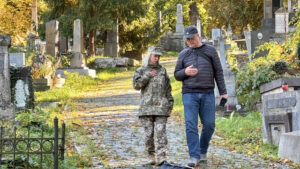
Tuba player Mike Knox, in his 55th season with the Rogue Valley Symphony, will give up his seat at the back of the ensemble
By Jim Flint
For nearly six decades, if you followed the low, steady heartbeat of the Rogue Valley Symphony, you’d eventually arrive at the back of the orchestra, where Michael Knox held court — quietly, reliably and with a tuba that anchored everything above it.
Knox is retiring this season after 55 years with the symphony, a tenure that stretches back to the orchestra’s earliest days and spans every conductor, countless performances and more stories than most symphony veterans could fit into a single lifetime. He joined as a teenager and leaves as a revered elder statesman, still sharp, still curious and still very much himself.
Despite often being described as the orchestra’s first tubist, Knox is quick to correct the record.
“I am actually the second tubist,” he said. The first was his friend Laurey Dixon, who played during the orchestra’s inaugural year in 1967 before switching to French horn to fill a need. Knox stepped in the following year, invited by founding conductor Frederick Palmer, beginning what would become a lifelong musical relationship.
Finding his footing
The early years of the orchestra were fluid and communal, with musicians coming and going as careers and lives evolved. Knox himself left in 1973 for a federal job in Michigan, returned to Oregon a few years later, and was rehired when the tuba chair again stood vacant.

From there, he stayed — not just for decades, but for generations.
Among his most vivid memories is an early broadcast concert at the Oregon Shakespeare Festival’s old Elizabethan Theatre, conducted by Carmen Dragon and featuring pianist Paulena Carter. It was a live radio performance on a hot summer day, bound by strict time limits and played to a packed house. Afterward, Dragon singled Knox out for praise.
“After the performance, Maestro Dragon came up to me, shook my hand, and congratulated me for such a fine performance of the Sibelius,” Knox said. “I was ecstatic for a week.”
Proud moment
That sense of awe never quite left him, even as his own reputation grew. One of his proudest moments came years later, playing Stravinsky’s “The Rite of Spring” under Arthur Shaw — with his son Eric seated beside him on second tuba.
“We played together, the ‘Entrance of the Elders’ part towards the climax of the piece,” Knox said. “I was very proud that he was sitting next to me, doing such a fine job.”
Another personal milestone was Knox’s performance of “Bydlo” from “Pictures at an Exhibition” — among the most demanding solos in the orchestral tuba repertoire.
“It is by far the hardest solo for orchestral tuba in the repertoire, and I nailed it three concerts in a row for him,” Knox said, with well-earned satisfaction.
Dents, dings and duty
For all the musical triumphs, there were practical challenges too — particularly for an instrument as large and vulnerable as a tuba. Knox learned early to make emergency repairs himself. Tubas, he notes, “get banged up a lot,” whether by careless footsteps or icy sidewalks.
After one winter fall bent his bell and damaged the linkage, fellow musician John Sleppy gave him his first lesson in instrument repair. “And the show went on,” Knox said — a phrase that could easily double as his professional mantra.
Knox has played under every RVS conductor, observing distinct styles but recognizing a shared commitment to education and growth.
“All of them were and are educators of the highest order,” he said.
RVS Music Director Martin Majkut described Knox as “a living memory” of the organization.
“He is friendly, constructive, thoughtful,” Majkut said. “You would not know that he has been coming to these rehearsals for five decades. Every time I see him, he has the same spark in his eye. He remains curious and possesses the same sense of wonder.”
Majkut said he will miss Knox’s “exemplary attitude,” on and off the stage.
“I do not think I have ever seen Mike grumpy,” he said. “Mike is an example of what can be accomplished when one commits to a long-term project with focus, tenacity and heart. I think he could build a cathedral with his attitude. I am glad he chose to play with us instead.”
Beyond the stage, Knox served on the Artistic Advisory Committee, sometimes encouraging programming strategies designed to balance innovation with familiarity. The goal was always the same: helping audiences grow without alienating them.
Beyond the back row
The decision to retire did not come lightly.
“Fifty consecutive years is a long time. Fifty-five overall is even longer,” Knox said. He joined at 19 and is now nearly 77. He loves what he calls “the best seat in the house,” likening himself to “a lineman on a football team, often the quiet, watchful, but necessary player.”
But a 14-month medical leave for cancer treatment forced him to confront life beyond the orchestra.
“I was scared about ever quitting the orchestra,” he said, “but my medical leave revealed to me that there was a life for me outside of the orchestra.”
That experience also clarified his values.
“I admire players who knew they were losing that magical vital edge and retired before they were invited to do so,” he said. “That takes bravery, and shows leadership.”
What will he miss? The people, above all.
“I’ll miss most the camaraderie of my fellow musicians, the inside jokes and the encouragement and guidance given,” he said.
What won’t he miss?
“I won’t miss that last half hour” of late-night rehearsals — though, as he adds, “a lousy rehearsal still beats a great night of TV.”
Knox hopes his legacy is remembered in practical ways: principal emeritus status, a continued listing in the program roster and a complimentary ticket for masterworks concerts. “We’ll buy an additional ticket for my wife,” he said.
Not retiring from performance
Retirement from the symphony does not mean retirement from music. Knox remains active with the Rogue Valley Symphonic Band, where he is a founding member, and the Ashland City Band, where he has completed 56 seasons. In the City Band, he occupies what he calls “The Preston Mitchell Chair,” honoring a fellow tubist who played until age 103. “He is one of my idols,” Knox said, “and it is my honor to occupy his chair.”
His musical tastes lean toward Dixieland and German bands, where improvisation reigns. He has carried a tuba mouthpiece around the world, sitting in with jazz musicians on Bourbon Street and connecting wordlessly with the original Buena Vista Social Club in Cuba. Music, he’s learned, transcends language, age and even mobility.
Cancer has changed his logistics — a rolling case instead of a backpack — but not his outlook.
“I attribute my strong recovery to the health of my lungs, and my constant exposure to new challenges,” he said. Going public with his diagnosis brought overwhelming support and unexpected connections, including a fellow symphony family member navigating the same disease.
A well-earned coda
Now, Knox and his wife Barbara are planning an ambitious 50th anniversary “honeymoon,” tracing a musical and cultural arc through Paris, London, Scotland, Ireland and beyond. They are birders, volunteers, recyclers and lifelong learners — deeply embedded in the community they’ve helped shape.
After a lifetime of music, Knox reflects on legacy in his own understated way.
“There is an informal definition used in the music community: ‘first call,’” he said. “I like to think I’ve held that status.”
His sound has been digitized, archived and shared, perhaps traveling farther now than his tuba ever could.
“My life has been golden,” he said.
For the Rogue Valley Symphony, that golden resonance will linger long after the final note fades.
Jim Flint’s Curtain Call column publishes on the second and fourth Mondays of the month. Email Jim at [email protected].