72 solar arrays planned for 6-acre site by Highway 99 just north of Ashland
By Craig Breon for Ashland.news
In a reversal of fortune, a proposed 6-acre solar installation on Ashland’s northwest side along Highway 99 appears headed for approval after a public hearing Monday, Dec. 1, before a county hearing officer. The proposal had been tentatively denied by staff, then appealed to the hearing officer by the applicant, Medella Bison Ranch.
The 1.4-megawatt (MW) facility would consist of 72 free-standing, pole-mounted solar arrays. Combined, the arrays would produce roughly 2,000 megawatt hours (MWh) per year, enough to power about 250 homes.
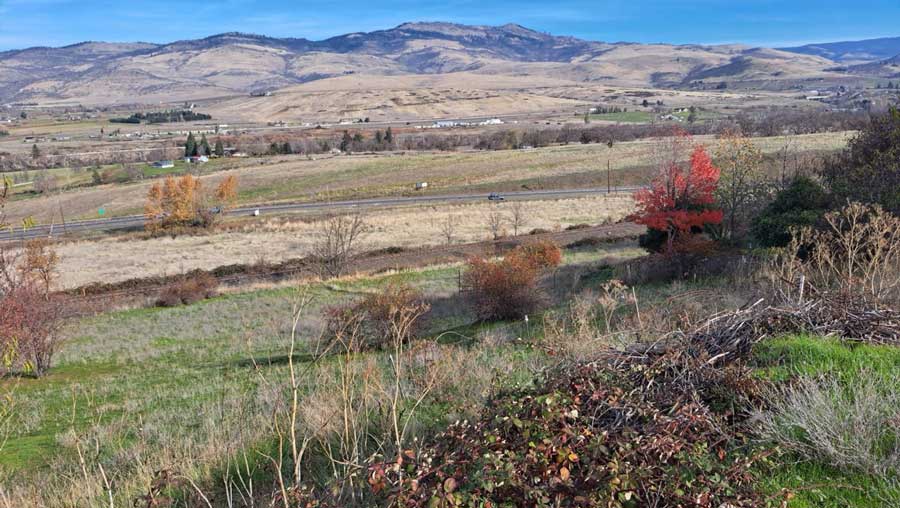
The 6-acre site is on county land, just outside the Ashland city boundary and outside the city’s urban growth boundary (UGB), meaning it is not currently slated for future urbanization.
The land is zoned EFU (exclusive farm use) and has a decades-long agricultural history, including grazing and hay production. State and county laws for lands zoned EFU are strongly worded to preserve agricultural lands long-term while allowing for limited conditional uses, including commercial solar energy production.

County staff first issued the tentative denial for the Medella Ranch’s application based partially on impacts to EFU lands and partially due to a lack of evidence to support the findings needed to place commercial solar on the site.
After that denial, representatives of Medella Ranch submitted further information regarding both the quality of soils on the site and what agricultural operations those soils and water availability make practicable, as well as supporting a contention that the proposed pole-mounted solar arrays will allow for continued grazing or forage-cropping of the land.
The public hearing allowed the hearing officer to consider both the original permit and the additional materials submitted, supplemented by further staff analysis and public testimony.

A land use hearing officer is designated by the county to adjudicate certain types of permitting disputes, such as conditional use permits and zoning changes. The officer, in this case Rebekah Dohrman, gathers evidence and makes determinations based on state and county laws, comprehensive plans and implementing regulations. The hearing officer also plays a fundamental role in ensuring public input. Once a hearing officer makes a determination, it is final and will be implemented by staff unless appealed to the state Land Use Board of Appeals (LUBA).
The hearing made clear that county staff was inclined to revise a number of their findings based on the additional information provided by Medella Ranch. In particular, potential impacts such as soil erosion and compaction, noxious weeds and fire breaks had been further addressed by the applicants.
Most of the public testimony at the hearing came from concerned neighbors, often focused on the visual impacts of a large solar facility, as well as farmland preservation.
“The impact is far-reaching,” claimed Daniel LosPalluto, homeowner on Ashland Mine Road, which overlooks the solar site from across Highway 99. He focused on the visual impacts from fencing and lighting in addition to the panels themselves, as well as concerns for wildlife movement through the site and construction impacts to the land.
Gerry Lehrburger, an adjoining neighbor to the site on Jackson Road, recalled the 170 years of family farming on the land prior to the current ownership, claiming the property was one of the longest-running, continuous farming operations in the region and a host to species such as bobcat and puma.
Martin Eldridge, another Ashland Mine Road resident, emphasized the impacts to the views and potentially to property values of those living uphill from the solar site.
“This is Ashland’s front door,” he said, noting that the site is also visible from Highway 99 as cars enter Ashland from the northwest.
Supporters spoke up as well. Jim Hartman, board president of Ashland Solar Cooperative, a collective of volunteers promoting solar in the community, noted that fencing would not be needed and lighting would be minimal. He felt that the proposed solar arrays would appear “like a work of art” and be more attractive than the car dealerships and self-storage units across the highway from the site.
Various representatives of the proposed solar project, including landowner Thaddeus Gala and Jeffery Sharpe, consulting engineer for the project, responded both to county staff concerns and public comment. They spoke of minimal impacts on the land from construction and operation of the solar arrays and the measures proposed for reducing soil erosion and compaction, such as reseeding. Gala, raised on an Oregon ranch and farming “since [he] could walk,” claimed the arrays could improve grazing by providing shade for the animals.
With public comment completed, county planner Frank Hernandez, admitting that “there’s a lot going on here,” clarified issues and provided staff perspective on the rationale behind a finding that the solar proposal, as amended, could likely meet the county standards for a conditional approval.
While sympathizing with neighbors regarding the visual impacts of the project, Hernandez explained that such concerns were largely outside the scope of project consideration, as the site is not mapped as a scenic resource for the county.
Before closing the proceedings, hearing officer Dohrman laid out the timeline for her decision-making. A deadline of Dec. 9 is set for adding additional material to the public record and Dec. 16 for responses to any such materials. She will issue her decision by Jan. 6.
Written comments must be submitted in hard copy via mail or hand delivery to:
Frank Hernandez
County Development Services Department
10 S. Oakdale Ave.
Medford OR 97501
Email Jackson County resident, consultant and former environmental law instructor Craig Breon at [email protected].
Related story: Solar energy project on north side of Ashland goes to county hearing Monday (Nov. 28, 2025)