Scenic Drive subdivision advances smoothly, while Ashland Street commercial project is delayed over a public-notice error involving planned tree removal
By Craig Breon for Ashland.news
At this week’s planning commission public hearing, a residential subdivision to create four new lots on Scenic Drive above Lithia Park received a green light while approval of two new commercial buildings along Ashland Street near Shop’n Kart hit a bump in the road and required a delay until January due to a mistake in the public notice.
Scenic Drive
The Scenic Drive subdivision presented issues related to steep slopes on the upper part of the land near Scenic as well as a desire to preserve several prominent trees on the site. To better address these constraints, the applicant, Rogue Planning and Development Services on behalf of the landowners Stanley Family Trust and Suncrest Homes, opted to pursue a Performance Standards Option (PSO) type subdivision permit.
A PSO subdivision differs from Ashland’s basic subdivision rules by providing relief from standards such as minimum lot sizes, lot width and depth, and building setbacks. Where topography, vegetation or natural hazards present a property with atypical challenges, the PSO subdivision code provides flexibility, “[as] necessary to protect the environment and the neighborhood from degradation.”
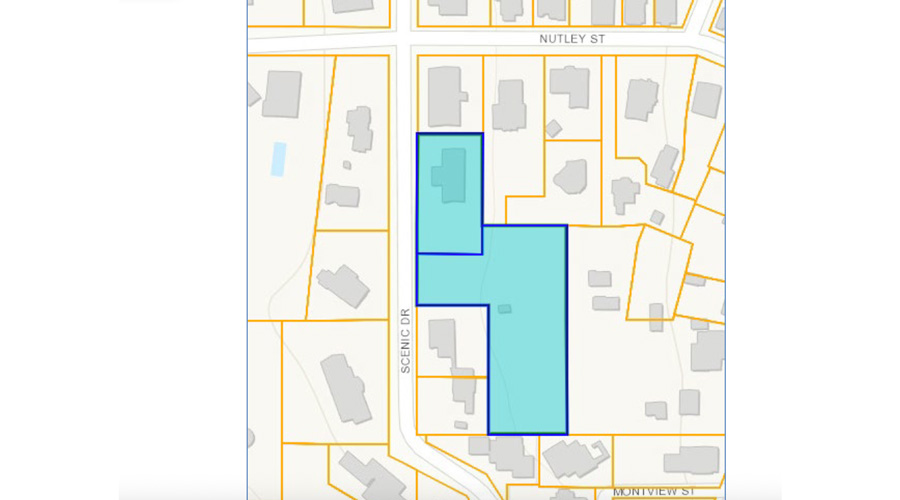
Slopes in excess of 35% just below Scenic Drive — essentially a drop-off — prevented the city from requiring standard street tree improvements along the sidewalk. Other slopes necessitated a driveway option buttressed by up to 10 feet of fill materials and a retaining wall.
Ten trees, including seven trees considered “significant” by city standards, had originally been proposed for removal from the site. After review by Ashland’s Tree Management Advisory Committee, two of those significant trees were proposed for preservation, though one of those two will likely be removed when the lot it sits on is later developed for a home.
Amy Gunter, representing Rogue Planning and Development Services, summed up the property as “tricky,” involving complex calculations of solar and shading impacts on surrounding homes in addition to the slope and tree issues. Having previously hosted what she described as a well-attended neighborhood meeting, no residents spoke in opposition to the subdivision at the public hearing.
Ashland Street
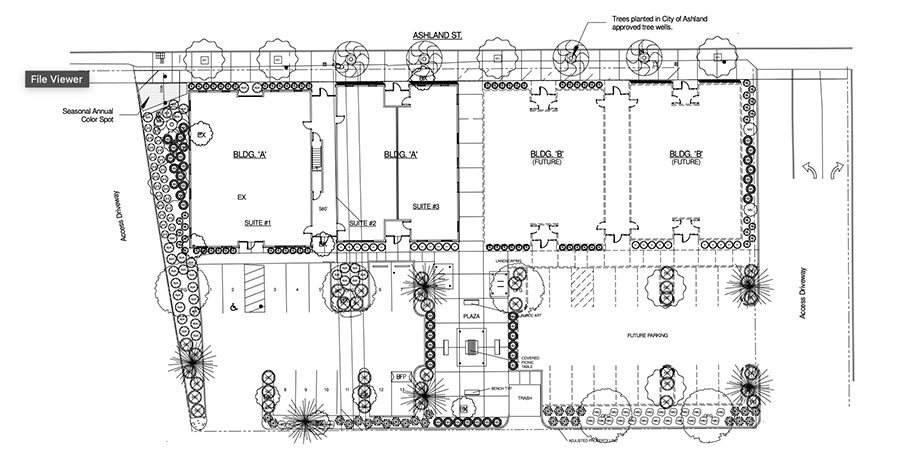
A small snag — literally about half a dozen trees — stood in the way of a quick approval for two 10,000 square-foot offices buildings proposed at 2262 and 2270 Ashland St., in front of the Shop’n Kart/Bi-Mart parking lot.
Acknowledging an “embarrassing” oversight, city planner Aaron Anderson informed the commissioners that final action could not be taken on the proposal because the public notice for that night did not include notice of tree removal.
Nonetheless, Anderson and representatives of Dan Horton Architecture and Reed Commercial Investment Properties made brief presentations to the commissioners and public, focusing on the buildings’ frontage on Ashland Street, design and landscaping for the two, two-story commercial buildings, and future uses of those buildings including, surprisingly, possible residential uses.
The two existing lots contain the former site of the Allergy & Asthma Center of Southern Oregon and the Yuan Yuan Chinese restaurant. Both those structures — deemed in poor condition by city staff and the applicant — would be torn down to make way for the office space.
The first building to be constructed (Building A) would house a chiropractic office and Shop’n Kart’s administration offices. The second building (Building B), on the Yuan Yuan restaurant site, would be constructed later, likely after tenants are secured.
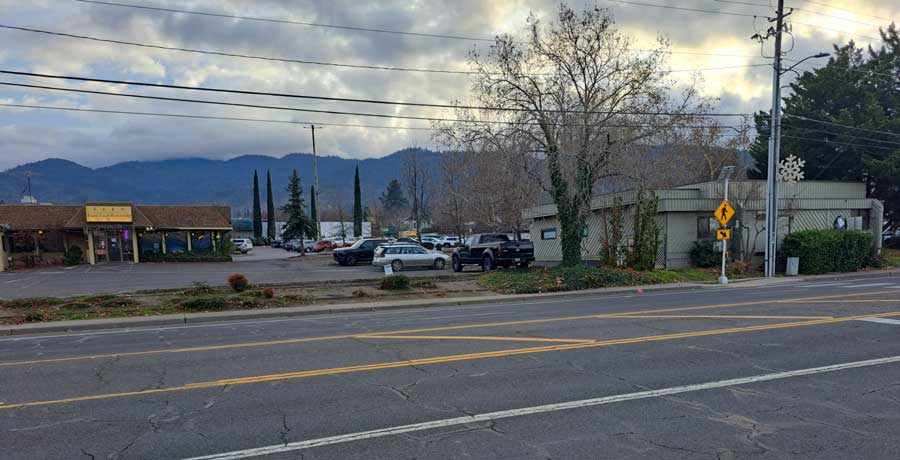
Street trees would be added to the frontage on Ashland Street, per Ashland design codes. To mitigate for removal of six or seven existing trees — reported to be in poor health — additional trees as well as shrubs and ground cover are included in the landscaping plans.
Parking would be to the rear, screened from Ashland Street by the buildings and including a small plaza space. Planner Anderson described the proposed aesthetics of the project as “clearly an improvement” over existing conditions.
Commission Chair Lisa Verner opened the project discussion by noting that this would be the first proposal following the designation of much of Ashland Street as a Climate Friendly Area (CFA) by the Ashland City Council. A recent state program requires large and mid-size Oregon communities to designate CFAs — areas of denser commercial and residential development — in order to encourage walkable, bikeable, and busable communities, reducing dependence on cars and associated greenhouse gases and pollutants.
The CFA discussion led quickly to a conundrum. The developers of the site wanted to include four apartments on the second floor of Building B. The CFA standards, however, dictate dense housing where residential is proposed. Complying with the CFA standards on the site would mean at least 21 apartments, likely in four-story buildings, according to Community Development Director Brandon Goldman.
Then came the end-around. A state law separate from the CFA program allows empty commercial space to be converted to residential units. Thus, following approval of this “commercial” development, some or all of Building B may be converted to apartments.
Commissioner Kerry KenCairn put it plainly, “[this is] effectively like a loophole.” Planning Supervisor Derek Severson dodged, “Not the term I used.”
Public comment on the Ashland Street proposal focused on the potential demise of Yuan Yuan restaurant.
Ashland resident Jonathan Griffin noted that Yuan Yuan has occupied the site for more than 20 years. He urged either a relocation plan for Yuan Yuan or compensation for the owners.
Erica Thompson, resident in the nearby Tolman Creek area, thanked Yuan Yuan for being open until 10 p.m. and supported keeping the restaurant in place.
Applicant Dan Horton acknowledged Yuan Yuan’s community value and pointed out that the restaurant could occupy a portion of Building B once constructed.
Due to the noticing error, resolution of the Ashland Street commercial building project was continued to the commission’s meeting at 7 p.m. Tuesday, Jan. 13.
Email Ashland resident, consultant and former environmental law instructor Craig Breon at [email protected].
Related stories:
Pair of public hearings Tuesday before Ashland Planning Commission (Dec. 7, 2025)