Ashland representative talks about housing production wins and federal funding woes
By Meg Wade for Ashland.news
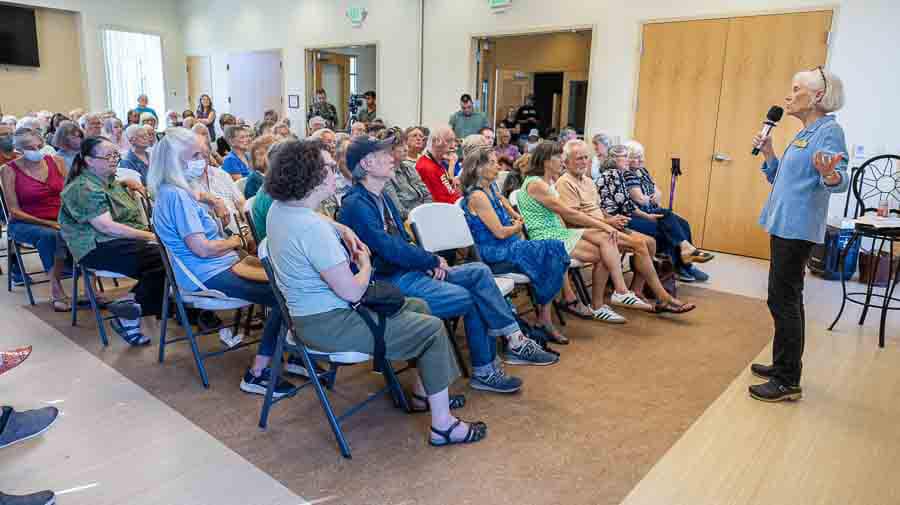
State Rep. Pam Marsh, D-Ashland, hosted a town hall and ice cream social at the Talent Community Center on Sunday afternoon, where the crowd filled the main meeting room and spilled over into the hallway.
Over the course of 90 minutes, Marsh reported on outcomes of the 2025 legislative cycle and expectations for the upcoming Aug. 29 special legislative session on transportation, and took audience questions on everything from the cost of home insurance to the presence of ICE in Oregon.

Transportation funding and special legislative session
Marsh began with the legislature’s failure to pass a comprehensive transportation package, while providing background on the changing funding landscape, which includes declining revenues from the state fuels tax due to the increased fuel efficiency of contemporary cars and higher usage of electric vehicles.
The fuels tax already did not account for inflation, she noted, creating shortages at the Oregon Department of Transportation (ODOT) even before difficulties in the legislative cycle and the withholding of federal grant dollars.
“This is a very important issue for us in Southern Oregon,” Marsh said.
“What does ODOT do? Well, they do lots of things, but they plow the roads in the wintertime. If we can’t keep I-5 clear, if we can’t get skiers up to Mount Ashland, if we can’t plow the parking lot at Mount Ashland; if we can’t keep the road to Klamath Falls clear, or 140, or the many avenues we need to move in the winter, then our recreational industry is undermined. It’s a matter of life or death in many cases.”

Marsh highlighted the proposals on the table for the special session, including a $.06 increase in the fuels tax to be split 50/50 between the state and local government, and an increase in the payroll tax to support transit, including Rogue Valley Transit District (RVTD), which operates area bus service.
“I know you’re concerned about Route 17 and Saturday cutbacks,” she said, when an audience member interrupted her.
“Route 61 is also a very important route for medical flights to Portland,” the woman shared from the middle of the crowd.
“If there’s a good thing about announcing cuts, it is seeing the community step up and talk about how much we value those services,” Marsh responded, and emphasized the importance of the payroll tax.
“To be clear, that will not take care of all RVTD’s problems,” she added, saying that the district would still be required “to be extremely lean.”
Federal funding decisions hit home
Funding difficulties were a persistent theme, especially during the Q&A session when audience members broached the subject of financial difficulties for both Southern Oregon University and Oregon Public Broadcasting, and upcoming cuts to SNAP (formerly known as food stamps) and Medicaid.
“To be clear: we cannot cover these vast gaps that the feds are creating,” Marsh said in regard to the Oregon Health Plan (OHP), Oregon’s Medicaid program. She called the work requirements mandated in the federal reconciliation bill, which will require verification every six months and an increase in the amount of paperwork necessary to stay insured, “a big ploy to get people to not use the system.”
Federal decisions also persistently changed the budget forecast legislators had to work with, and Marsh talked about handling “economics in real time” as budget calculations would be revised week-to-week after presidential comments about tariffs and changing risks for a potential recession.
“Over the course of the six-month long session,” she said, “the budget just got worse and worse.”
When it comes to SOU, Marsh talked about a “need to reorient” and “to have a regional university strategy” that “changes our relationship to the funding model, because we should be using a funding model that is specific towards the need of the regionals — not a funding model that is standardized for the big research universities. That’s where I think our opportunity will be to reposition ourselves.”

Funding for schools, wildfire mitigation, and shelters
The legislature did increase funding for some programs and find new or more stable sources of funding for others.
This includes what Marsh described as a “breakthrough moment” in determining funding sources for wildfire mitigation and suppression via HB 3940, which establishes a new tax on oral nicotine products and also re-directs interest money on the state’s Rainy Day Fund.
K-12 education also received $11.4 billion, including money to make summer school funding permanent, improving the ability of school districts to plan and staff their summer school programs.
But the educational funding comes “with some caveats,” Marsh clarified, noting that many Oregon residents are concerned that funding hasn’t always led to “good outcomes for kiddos.” SB 141 establishes metrics for school districts and allows the state to step in and make decisions about local uses of state funds for a district if the metrics are not met.
HB 3644 also creates a statewide program for funding shelters. Marsh said the purpose of the program is to “keep the shelter system stable,” and not necessarily expand it.
Grants Pass City Councilor Victoria Marshall questioned Marsh about how effective the program would be for Southern Oregon.
“It’s finally an effort to fund some of the treatment and housing programs that might help cities,” Marshall said, then asked, “What hoops will cities have to jump through in order to get funding from HB 3644? Many times, all that funding stays up in Portland. So will that funding come down here for the homelessness crisis?”
Marsh said she believed that the distribution model, which features regional organizations that will receive and disburse funds from the state, would offer transparency and fairness and “empower communities to spend [the funds] in ways that reflect what the communities want.”

Housing legislation
Marsh, who is the Chair of the House Committee on Housing and Homelessness, sponsored and supported multiple pieces of legislation this year with the intent of boosting housing production. These include:
- HB 3145, which allocates funds from the Local Innovation and Fast Track Housing Program Fund to pre-fabricated, modular, and manufactured homes;
- HB 3746, which limits the liability of condo developers, with the aim of encouraging more condo development;
- HB 3589, which creates an initiative to increase housing for older adults and persons with disabilities; and
- HB 2258, which allows the Land Conservation and Development Commission to develop pre-approved housing plans that meet state and local codes and expedite a developer’s path through land-use approvals at the local level.
- HB 3054, which limits rent increases at mobile home parks to 6% per year, also passed.
Energy affordability and data centers
Marsh also highlighted HB 3179, which places some limitations on when and how utility companies can increase rates for users, and requires the Public Utility Commissions to consider the impact of rate increases on consumers.
She then discussed HB 3546, which aims to make sure that companies placing data centers in Oregon bear the full cost for their energy use and that other ratepayers are not subsidizing that use.
Marsh said the bill was her “baby,” and although it aimed to let companies know that “we welcome your data centers,” it sought to account for their impacts on communities more fully.
“A 30-megawatt data center,” Marsh said, “can be constructed in one-and-a-half to two years, and would use as much electricity as the entire city of Ashland.”
HB 3546 also requires new data centers to enter into a ten-year contract to ensure that public investments in new infrastructure to serve such centers are fully recovered.
Changes in civil commitment laws; beaver protections
Additional legislation highlighted at the town hall included HB 2005, which makes changes to the state’s civil commitment laws, making it easier to both force someone with severe mental illness into treatment, and HB 3464, which expands protections for beavers.
Safeguarding Oregon: federal oversight forum Thursday
During the Q&A session, while some audience members had more lengthy comments, one attendee kept their question short and direct: “I want to hear, what can the state do to control ICE?”
While Marsh emphasized Oregon’s sanctuary state laws, she also invited the speaker to come and direct her question to Attorney General Dan Rayfield at another town hall event, scheduled for this Thursday.
That event, “Safeguarding Oregon: Federal Oversight Forum,” will be held at 6 p.m. Thursday, Aug. 7, in Stevenson Union on the Southern Oregon University campus, 1250 Siskiyou Blvd.
Attendees are encouraged to sign up in advance online if they would like to give public comment or ask a question.
Email Ashland resident and freelance journalist Meg Wade at [email protected].
Related stories:
SOU President: ‘Today we are declaring exigency,’ ‘building’ to a $60 million university, 15% off current budget (Aug. 2, 2025)
Oregon AG Dan Rayfield to host SOU town hall about federal cuts Thursday (Aug. 1, 2025)
Ashland Circulator to shut down as RVTD board cuts services (July 24, 2025)
Kotek’s transportation plan: 6-cent gas tax increase, registration fee hikes and doubled transit tax (July 23, 2025)
Southern Oregon public media faces huge shortfalls after Senate votes to cancel funding (July 16, 2025)
Gov. Kotek proposes using $160 million from state’s ‘rainy day fund’ for one-time wildfire funding (June 18, 2025)