It opens this weekend with Shakespeare scholar Barry Kraft’s exploration of the Bard’s most elusive tragedy
By Jim Flint for Ashland.news
The 2026 season for Rogue Theater Company opens not with a curtain rise, but with a deep dive into Shakespeare’s most elusive tragedy.
On Saturday and Sunday, Feb. 7 and 8, longtime Shakespeare scholar Barry Kraft will lead an exploration devoted entirely to “Hamlet” — his favorite play — offering participants the option to attend in person, via Zoom, or by accessing recordings afterward. Both sessions will run from 10 to 11:30 a.m.
For Kraft, the pull of “Hamlet” stretches back decades.

“It was 70 years ago I was first bitten by the ‘Hamlet’ and theatrical bug,” he said. Kraft was cast in a small role in John Carradine’s final production of the play at the Laguna Beach Playhouse and, he said, “I was ecstatically hooked!”
That experience sparked a decade-long immersion in the text.
“For the following 10 years I read everything I could written about ‘Hamlet,’ and saw every televised production I could get my hands on,” Kraft said. By age 22, that devotion paid off, when he landed the title role at the Colorado Shakespeare Festival.
Now, he brings that lifetime of study to Ashland audiences, setting an intellectual and emotional tone for a season that leans into intimacy, moral complexity, and human connection.
One night, two lives
From that foundation, RTC moves on to its first fully staged production of the year: Bruce Graham’s “Stella and Lou,” running March 11-29. Directed by Henry Woronicz and starring OSF veterans Linda Alper and Michael J. Hume, the two-character play unfolds over one quiet night in a neighborhood bar, tracing friendship, loss and the possibility of renewal.
Woronicz, a former OSF artistic director, said he was drawn to the piece for the same reasons that have guided his career.
“Like all plays of this scale and intimacy, I was attracted to the characters’ stories and the arc each of them must travel as those stories play out on stage,” he said. “This play in particular is very much about dealing with loss and finding that second chance, and then being willing to take the leap. And we never know where they might land, which makes the story very compelling.”
Old friends, new work
Working with Alper and Hume brings its own resonance.

“I have known and worked with both Linda and Michael for over 30 years,” Woronicz said. “Their individual and collective gifts and experience will be enormous assets to this production, and I’m so honored to be working with them once more. And the fact that we’re close, old friends, as well as longtime colleagues, is simply the cherry on the top.”
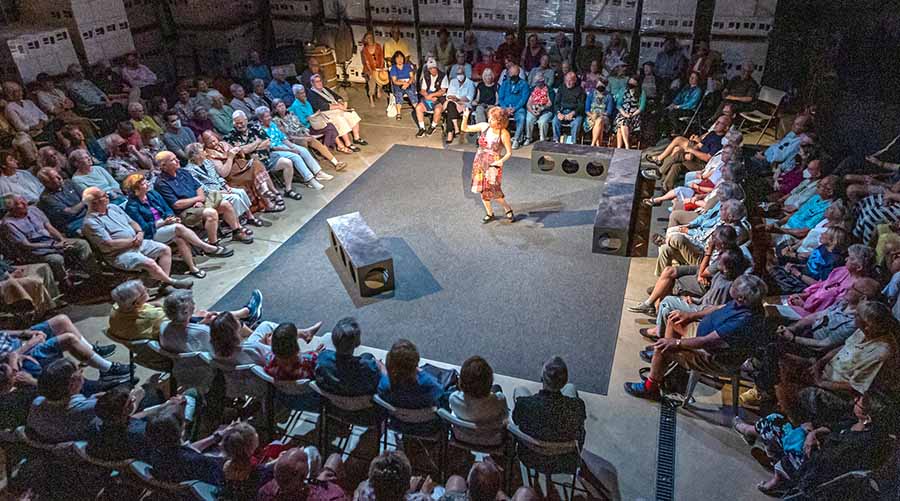
The intimate setting of Lou’s Bar mirrors RTC’s own small performance space, something Woronicz sees as an artistic advantage.
“With this intimate script and the small playing space, it can actually give the actors a real advantage,” he said. “In a small space, actors can work softly, more internally. They can be simpler and more honest and closer to the chest, digging into these characters’ contradictions and pain.” He added that the proximity creates a special bond with audiences: “The audience is never far away, they’re right in the room with you, almost at your elbow.”
RTC Artistic Director Jessica Sage said she sees “Stella and Lou” as the emotional entry point to the season.
“The through line begins with the play, which invites the audience into something intimate, tender and deeply recognizable — a story about love and the quiet ways we care for one another,” she said.
Expanding the conversation
From there, the season widens in scope and urgency.
“My hope is that audiences move through the season feeling both unsettled and deeply connected,” she said, “challenged by big ideas about history, ethics and power, and also moved by the very human cost of those ideas.”
The season continues April 29 through May 3 with a staged reading of Tony Kushner’s “Angels in America, Part I: Millennium Approaches,” directed by Desdemona Chiang. The eight-actor cast includes Jordan Barbour, Christian Bufford, Lini Dissanayake, Robin Goodrin Nordli, Jeffrey King, Benjamin Pelteson, Stephen Michael Spencer and Vilma Silva.
Sage describes the choice as intentional.
“The reading format strips away spectacle and puts the audience in direct relationship with the text and the actors,” she said. “With eight actors taking on multiple roles, the theatricality comes from transformation and imagination rather than production scale. It asks the audience to lean in, to actively participate, instead of being carried along by design.”
The season’s final turn
Summer brings Nick Payne’s “Constellations,” July 15 through Aug. 2, directed by Emily Moler and featuring husband-and-wife performers John Tufts and Christine Albright. The season closes Oct. 14-Nov. 1 with Ariel Dorfman’s “Death and the Maiden,” directed by Nancy Carlin and starring Elijah Alexander, Nell Geisslinger and Jamie Newcomb.
Sage described that final offering as a deliberate reckoning.
“Ending the season with ‘Death and the Maiden’ feels both deliberate and necessary,” she said. “Our season ends not with resolution, but with a challenge: to sit with ambiguity, to listen deeply and to consider what justice demands of us when the answers are anything but simple.”
All productions take place in the Richard L. Hay Center at Grizzly Peak Winery, 1600 E. Nevada St., Ashland, with performances at 1 p.m., Wednesdays through Sundays. For tickets or more information, go to roguetheatercompany.com.
From Kraft’s scholarly excavation of “Hamlet” to the quiet courage of “Stella and Lou” and the moral intensity of the works that follow, RTC’s 2026 season favors precision over spectacle — inviting audiences into close quarters with big questions, and reminding them, as Woronicz put it, of “the shared energy of storytelling and what the theater can do so well: reminding us what it means to be human.”
Freelance writer Jim Flint is a retired newspaper publisher and editor. Email him at [email protected].