In a Talent warehouse, thousands of festival costumes are preserved and reused, then sent to stages across the country
By Jim Flint
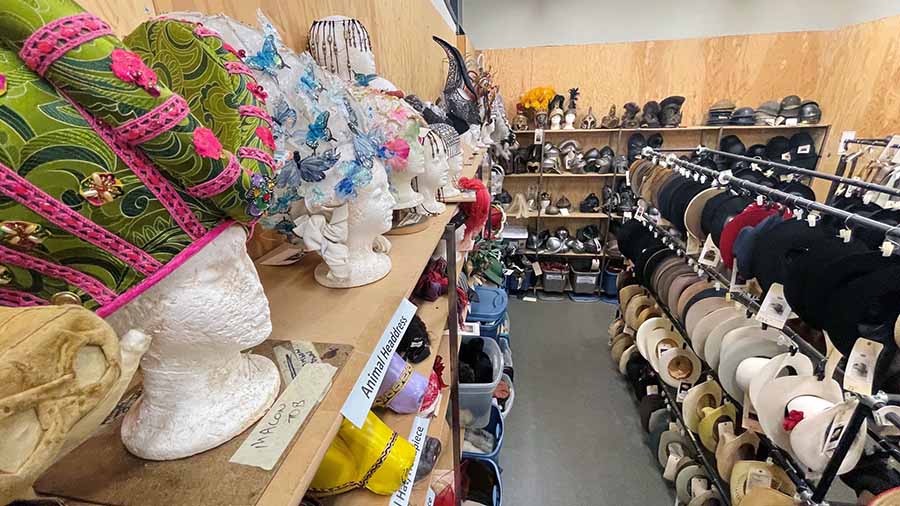
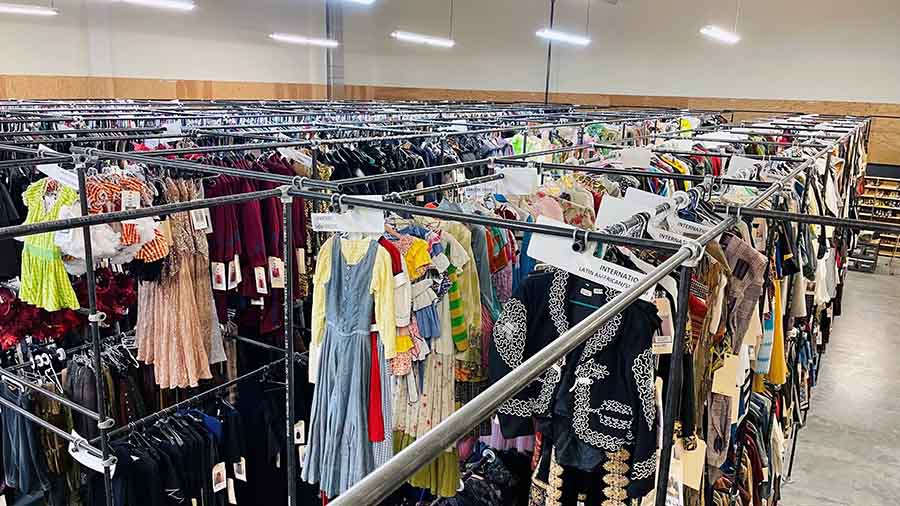
In Talent — seven miles north of the Ashland stages where swords clash, lovers spar and monarchs fall — tens of thousands of costumes line rolling racks inside a large warehouse on Talent Avenue. They are not relics. They are working garments, each one tagged, photographed, barcoded and ready to be called back into action.
This is Oregon Shakespeare Festival Costume Rentals, an operation that functions less like a warehouse and more like a living archive. Here, doublets from decades past hang beside gowns sewn for productions only recently struck. The space hums with a particular kind of backstage afterlife: costumes built for one story, now poised to tell hundreds more.
For more than 20 years, OSF Costume Rentals has been extending the lifespan of the festival’s famously detailed wardrobe — sending Shakespearean finery, Victorian coats, Regency gowns and fantastical creations to theaters, universities, film sets, television studios and photo shoots across the United States.
“Saturday Night Live” is one of Costume Rentals’ high-profile clients, contacting OSF regularly for specific period pieces. One particularly notable rental was a gown from OSF’s production of “Pride and Prejudice” that was worn on SNL by Al Pacino.
A backstage fire in the original Elizabethan Theatre in 1940 destroyed nearly all of the company’s costumes and some of the stage. The show went on, with performers wearing modern clothing for subsequent performances while seamstresses worked to create replacement costumes.
Today, purpose-built storage facilities like the Talent warehouse help guard against such losses. Organized storage, professional handling and modern inventory systems help ensure that costumes are preserved safely and remain available for reuse far beyond their original productions.

What began as a practical solution to storage has become a national resource, shaped by artistry, logistics, technology and a philosophy that sees reuse not as compromise, but as continuity — as well as a supplemental revenue stream.
The big picture: A working archive
OSF’s production building in Talent spans roughly 70,000 square feet, but the Costume Rentals operation occupies about 11,500 of them — a dense, carefully organized ecosystem within the larger complex. Inside are thousands of individual pieces, each one tracked with meticulous precision.
“We house over 30,000 items which are individually barcoded, described, photographed, tagged and stored in the warehouse,” said Alice Risser, OSF’s costume director.
The scale reflects OSF’s identity as a repertory theater, where variety is not a programming choice but a structural mandate. In a single season, the festival may stage works spanning centuries, continents and aesthetics. When a season closes, its costumes do not disappear — they migrate.
“For over 20 years, OSF Costume Rentals has given new life to the incredible costumes made for the OSF stage,” Risser said. “Through costume rentals, we have been able to collaborate with theaters, film, television and educational organizations across the nation.”
What sets the collection apart is not just its breadth — from Ancient Greece and Rome to modern dress and imagined worlds — but its accessibility. Unlike many costume houses that rely on in-person pulling, OSF’s inventory is available online.
Clients and demand: From Shakespeare to the holidays
“This online access is a rarity as far as costume houses go,” Risser said.
Most of the requests that arrive at OSF Costume Rentals come from professional theaters and universities, many of them mounting Shakespeare or historically grounded productions.
“We are best known for our extensive selection of Shakespearean, Elizabethan costumes and receive many requests for Shakespeare plays as well as historical productions,” said Celina Gigliello-Pretto, the costume rentals supervisor.
Demand follows the rhythms of the theatrical calendar. Late in the year, the warehouse fields a steady stream of inquiries tied to holiday programming.
“Towards the end of the year, we often get requests for seasonal productions such as ‘A Christmas Carol,’ ‘Christmas at Pemberley’s,’ etc.,” Gigliello-Pretto said. “We have a wide selection of costumes in the Victorian era to choose from, which makes us the perfect place for these types of shows.”
Trends shift, too. In recent seasons, the Regency era has surged in popularity, mirroring programming choices nationwide, “with institutions often doing shows such as ‘Pride and Prejudice’ or ‘Sense and Sensibility,’” she said.
That demand has even shaped new construction.
“Our costume shop made new regency gowns this past year to accommodate the influx in requests and to make our selection more size inclusive,” Gigliello-Pretto said.
Revenue, strategy and staying power
While Costume Rentals serves clients nationwide, its first obligation is local — and internal. The department functions as an extension of the costume shop rather than a separate enterprise.
“OSF Costume Rentals is an invaluable resource to our theater,” said Malia Argüello, OSF’s director of production. “We serve first and foremost as a closet to the Oregon Shakespeare Festival.”

Pieces return to the stage again and again, sometimes transformed in the process.
“Anything in our stock can and has been reused by OSF time and time again, sometimes even being remade into something entirely new,” Argüello said.
The rental operation also supports OSF beyond its production needs.
“Costume Rentals is a subdepartment that works with many parts of the festival, such as education, development, and engagement,” she said. “We supply costumes for the Gala (an annual fundraising event), educational displays, the school visit program, and more.”
The program’s current home dates to 2013, when the Talent production building opened and rentals relocated from a smaller Ashland warehouse. Since then, the operation has matured into a logistical and artistic anchor — one that keeps garments in circulation rather than just in storage. Through repeated reuse, the costumes are routinely laundered, repaired and maintained over years of service.
Behind the scenes: From click to curtain call
Most rentals begin online. A client builds a digital cart, signs a rental agreement and submits a request. From there, the process becomes tactile.
“One of our staff members will then pull the items and contact the client to discuss their rental order,” Gigliello-Pretto said. “The next step is for our staff member to scan the items out to the order, remove the tags, file paperwork, receive a deposit, and finally pack and ship the rental order using FedEx or UPS.”
Maintaining the collection requires a rare blend of skills.
“The work we do in Costume Rentals requires extensive knowledge of fashion history, theater, textiles, and garment construction,” Gigliello-Pretto said. “A design background is additionally very useful when a client has a less specific request in mind.”
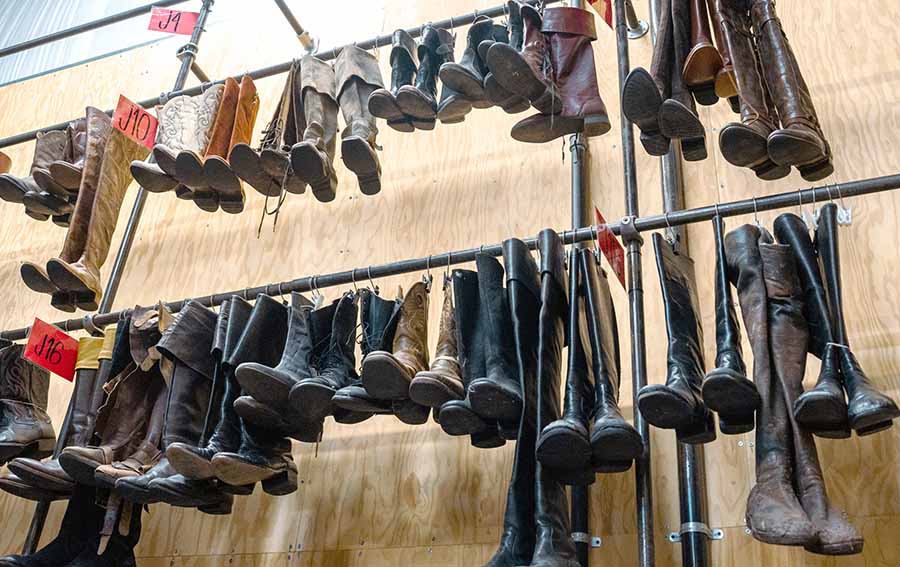
Preservation is a constant balancing act. Items are cycled back into stock until they can no longer withstand use.
“A perk of being a part of the costume department at OSF is the collaboration with our incredible artisans, drapers, stitchers, and laundry technicians,” Gigliello-Pretto said. “It is because of this partnership that we can repair, launder, and maintain the tens of thousands of items in our stock.”

Craftsmanship that endures
Durability is not an accident. From the start, OSF costumes are built to last far beyond a single run. The talent in the costume shop is a key to the success of OSF Costume Rentals.
“Each garment is made with care and intention to last not only our nine-month season, but to last lifetimes past that through rentals,” Risser said.
Design choices reflect that philosophy.
“Many of our garments are constructed with 4-plus inches of seam allowance to allow them to be worn by different-sized bodies,” she said. “The alterability as well as durability of our costumes is what makes them perfect for use in future productions.”
Some pieces stand out within the collection.
“Our impressive collection of over 500 doublets is one of the most historically significant,” Risser said. “Some doublets date back to the 1970s and even earlier.”
Others are recognizable to audiences.
“Clients often will have seen our productions and request certain items,” she said. “We have many pieces for rent from iconic OSF productions such as ‘Into the Woods,’ ‘Shakespeare in Love,’ ‘Head Over Heels,’ ‘The Wiz’ and more.”
Technology, sustainability and access
Behind the racks is a digital infrastructure that keeps the operation nimble.
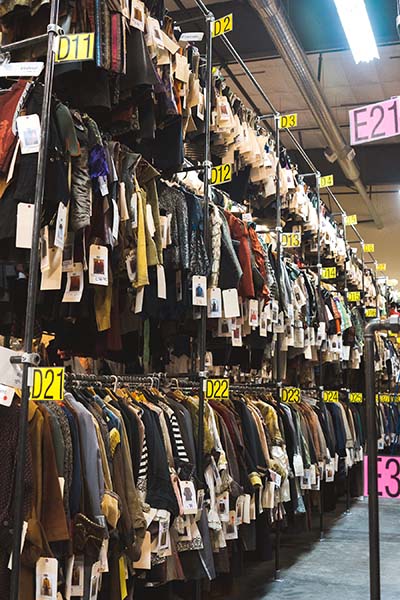
“We use a third-party inventory system to manage and organize all our stock,” Gigliello-Pretto said. “This system directly links to our website where all our items are searchable.”
That accessibility aligns with OSF’s broader values. Sustainability, Risser said, is baked into the program’s purpose: “We strive to reuse anything we can and reduce waste and overconsumption.”
Costume Rentals plays a crucial role in that effort.
“While other departments may be able to reuse materials, fabrics that have been cut and worn cannot easily be reused,” Risser said. “Costume Rentals allows for the stock to be reused in future productions at OSF where costumes are often refit to tell new stories.”
The program also prioritizes education.
“Costume Rentals offers a 50% discount to all educational and community organizations in the nation,” she said. “We know the value of theater and strive to be an accessible resource to young audiences.”
A living collection
In Talent, the racks never stop moving. Costumes leave for distant stages and return altered by travel, sweat and story — repaired, refreshed and ready again. What might look like storage is, in fact, circulation.
The clothes that once defined a single OSF season now carry traces of many productions, many casts and many audiences. In that way, Costume Rentals is not just preserving the past. It is quietly shaping the future of American theater — one garment at a time.
This story originally appeared in Oregon ArtsWatch.
Freelance writer Jim Flint is a retired newspaper publisher and editor. Email him at [email protected].