City policy makers cope with rising mandated costs, uncertainty at federal level
By Damian Mann for Ashland.news
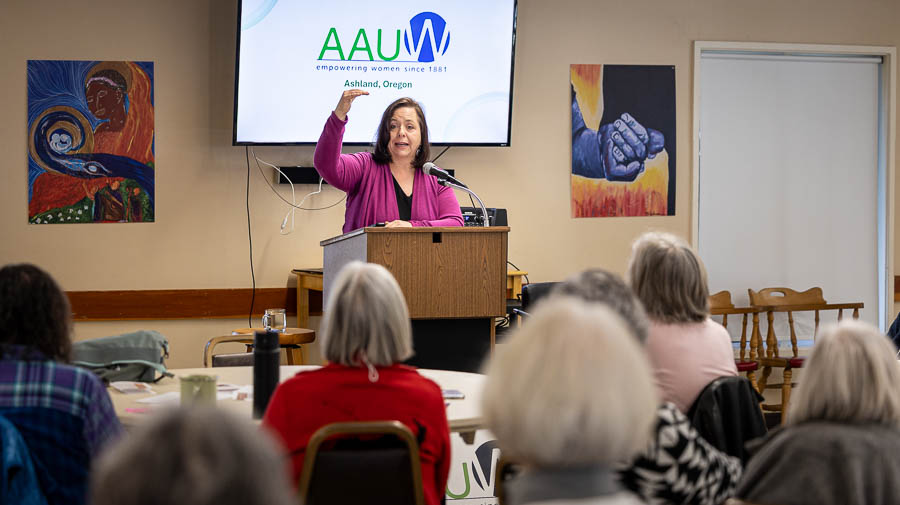
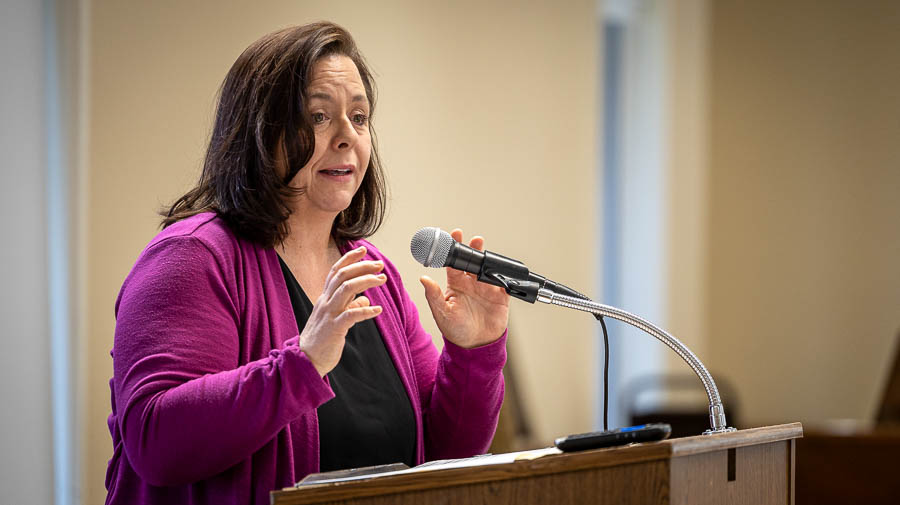
Ashland Mayor Tonya Graham on Saturday assured members of the Ashland branch of the American Association of University Women (AAUW) that she sees a path through complex city issues despite a less reliable federal government.
“We have to hold fast to the idea that there is a better world on the other side of the disruption,” Graham said.
She referenced the year 1881, when the AAUW was founded, and how the world has changed since then.
Graham said progress has ebbed and flowed over the intervening years.
“There are times of great disruption,” she said. “We are in one of those moments right now.”
Graham spoke for an hour to about 50 people at the Calvin Hall of the First Presbyterian Church of Ashland as part of the AAUW annual public policy meeting.
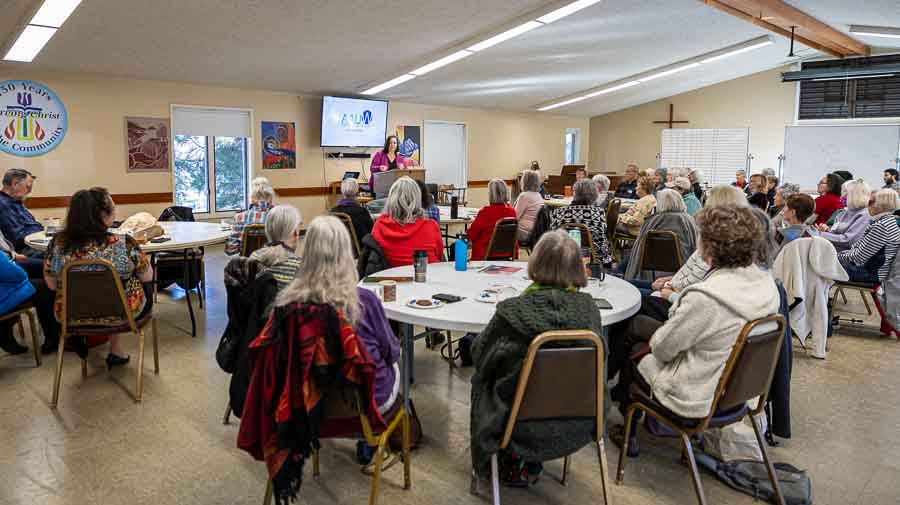
Susan MacCraken Jain, president of the AAUW, and Lisa Werner, public policy chair for the AAUW, introduced Graham.
“I have to say, I’m so impressed with her abilities,” Werner said. “She’s here today to discuss where we are going and Ashland’s future.”
Graham said it’s groups such as the AAUW that help communities navigate through disruptive times by rallying local people to support their community.
She asked the members to talk to friends and neighbors who might be interested in joining one of the many city committees that take “deep dives” into local issues.
Graham said cities across the country once could count on the federal government to adhere to contracts that provide grants locally.
“We thought the law would be respected by government officials,” Graham said, noting that city, state and federal officials all take oaths to support the Constitution.
“None of those things can we rely on anymore,” she said.
Despite these headwinds, Graham said the city continues to make progress.
She said the fate of a $73 million U.S. Water Infrastructure and Innovation Act loan was unclear for most of last year due to action — or lack of it — by the federal government.
“It got stuck for months,” she said.
The loan was needed by the city to finance a new water treatment plant that will be located in an area less vulnerable to wildfires and flooding, and large enough to accommodate more extensive water treatment.
She said the treatment plant is the lifeblood of the community.
“If you let it fail, it is an existential threat to the community,” she said.
The loan is tapped into as needed to support the construction of the new plant, she said.
Even with the loan, the city is looking for other grants to help support the project and to help lessen the amount the city would need to borrow.
Reducing wildfire risk, one of the reasons the plant is being moved, is an ongoing effort of the city, she said.
Not only are the forests above Ashland managed, but Graham said there are local efforts to minimize the spread of a wildfire “so embers are not lighting businesses and residences on fire.”
“We have to continue to be at the forefront of wildfire risk reduction,” she said.
Graham touched on many other local issues, including affordable housing, climate change, financial sustainability, and infrastructure improvements, such as the water treatment plant.
She said civic buildings are suffering from years of deferred maintenance, prompting the City Council to look at ways to consolidate city functions and to sell or lease some buildings. The fate of the downtown City Hall is one of the buildings in play. Voters rejected an $8.2 million bond measure in 2020 to remodel City Hall.

Any consolidation and potential divestiture of properties will require outreach to the community to determine what the consolidation might look like and where the consolidation would take place.
“Right now, city services are scattered around the community,” she said.
Ultimately, the city will likely seek voter approval for a bond measure for the consolidation, Graham said.
To address the housing shortage, the city has created a new “express lane” that will help property owners build accessory dwelling units, or ADUs, to provide additional housing options throughout the city, she said.
The city has a free set of plans that property owners can use to build the ADU and has created an easier process to get planning approval.
‘State of the City’
Click here for more information
Ashland Mayor Tonya Graham is set to give her annual ‘State of the City’ talk during the city of Ashland 2026 Town Hall Gathering set for 5:30 to 7 p.m. Wednesday, Jan. 21, in Mountain Avenue Theatre at Ashland High School, 201 S. Mountain Ave. The evening will also feature a short film highlighting City accomplishments from the past two years, followed by the presentation of The James M. Ragland “Volunteer Spirit” Community Service Award and The Alan C. Bates Public Service Award.
Graham said the city has started a land-bank program that sets aside lots in developments for affordable housing units.
Graham said the city needs to work harder to create “attainable housing” for the many people who work in Ashland but live elsewhere.
She said these families that work here, but live elsewhere, don’t put their children in Ashland schools, which exacerbates the declining enrollment problem for Ashland School District.
On climate change, she said the impacts are already showing up with more devastating wildfires and prolonged fire seasons.
“It is real and it is dangerous,” she said.
She said the city requires that new developments shift to electric appliances and avoid natural gas. At the same time, the city, which is the electric provider, wants to continue to make sure that the electricity is generated cleanly and in an ecologically sustainable way.
She said the city has made it easier for families to qualify for energy assistance programs, which are now based just on income.
Many small businesses have complained about city codes being difficult to deal with, so the city is working on ways to make them easier to understand, Graham said.
Refining city codes to make them easier for local businesses that want to expand or add new signs, is already in the works, she said.
An audience member asked about the overall health of the city.
“Unlike the federal government, we are required to have a balanced budget,” Graham said.
She said maintaining the budget requires constant cinching, because inflationary pressures and new regulations create additional pressures on the city that outpace the revenues that flow in.
“Overall, the city is carrying very little debt,” she said.
In the near future, the city will have a discussion with the community about potential cuts to services to help maintain a balanced budget.
Graham has a website that details many of the city’s issues: TonyaForAshland.com.
Reach freelance writer Damian Mann at [email protected].