Shireen Abu-Khader heads a moving, at times breathtaking, performance of Middle Eastern music at SOU presented by Anima Mundi
By Lucie K. Scheuer for Ashland.news
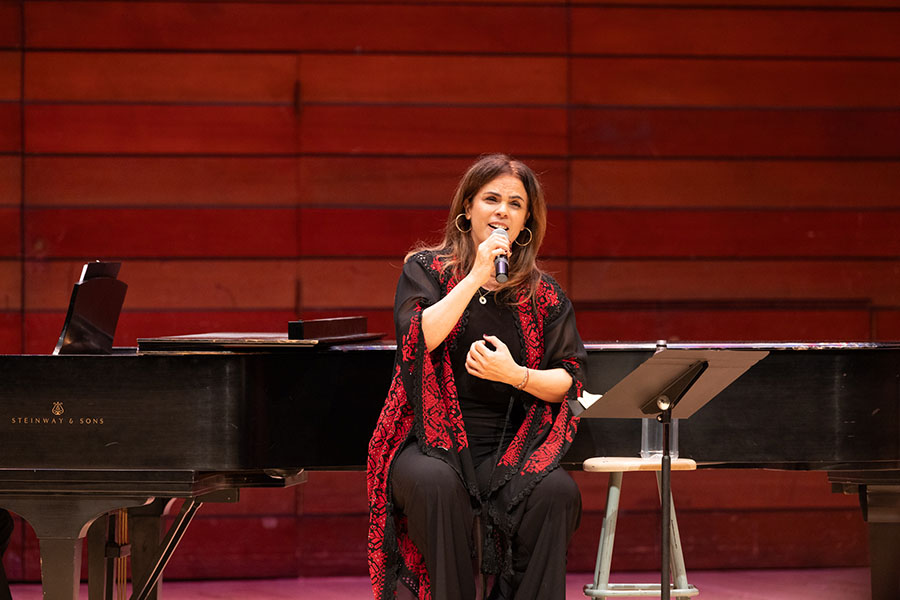
As part of its Heart of Humanity series for 2025-26, Anima Mundi Productions was finally able to present Shireen Abu-Khader, an internationally recognized, dynamic Palestinian-Jordanian-Canadian choral leader, vocalist and composer-arranger of Middle Eastern music, at Southern Oregon University’s Music Recital Hall last weekend.
This concert was almost a year in the planning and fraught with challenges. There were times when Anima Mundi wasn’t sure they’d be able to get Abu-Khader here, due to ongoing scheduling conflicts, logistics and newly imposed travel restrictions for various groups. Then at the last minute, Abu-Khader suffered a back injury that made it difficult for her to perform.
One of the biggest obstacles appeared in October, when Abu-Khader decided there may be visa or travel delays for some of her ensemble coming from Toronto, where she now lives and works. She made the executive decision that if her entire ensemble, which performs as a team and is made up of many Middle Eastern nationalities, couldn’t make the trip smoothly, they wouldn’t make it at all.
Two-part concert
It was then that she and producers Ethan Gans-Morse and Tiziana DellaRovere decided the concert would consist of two parts: A live concert with Abu-Khader and a filmed concert: “The Songs She Became” by noted filmmaker Mariam J. Momani, featuring Abu-Khader’s USUL ensemble and the pictorial inclusion of various scenes from Middle Eastern life.
The concert on Sunday, Dec. 7, proved to be worth the wait — but wasn’t without its challenges. Most of the performers were soft-spoken, and the mics were not augmented, so it was difficult to hear the stories and meaning behind the various folk tunes presented. This in turn made it difficult to appreciate the songs to their fullest. Nevertheless, there were some deeply moving pieces and deeply personal references to the sacredness of motherhood and its relationship to nurturing life.
Abu-Khader’s voice is deep, ethereal, mesmerizing and so complimentary to the maqams (Arabic melodies found in Middle Eastern and Andalusian traditional music with meandering rhythms and microtonal intervals) which she has successfully married to Western harmony. The results can, at times, be breathtaking.
She was accompanied by Gans-Morse on piano and Aharon Wheels Bolsta on drums and flute. Bolsta is an accomplished instrumentalist whose interpretations have been influenced by the music of many folk traditions spanning several continents.
Middle Eastern folk songs
Abu-Khader began the concert by singing several folk songs from Levantine, Syrian, Bedouin and Palestinian folk song traditions, about love, relationships and death.
One of them, “If I Must Die,” is an extremely moving piece that entreats the listener “If I die, you must live to tell my story.” The lyrics are taken from a celebrated poem by Palestinian professor and revered writer Reefat Alareer, who lost his life in December 2023 in an Israeli airstrike in northern Gaza.
Although this was a concert devoid of politics, Anima Mundi reminded us that conflicts such as the one in Gaza continue throughout the world. Hence, Anima Mundi’s focus on promoting peace and its concert presented earlier this year by Israeli cellist Amit Peled and Spanish concert pianist Daniel Del Pino on Jewish musical tradition.
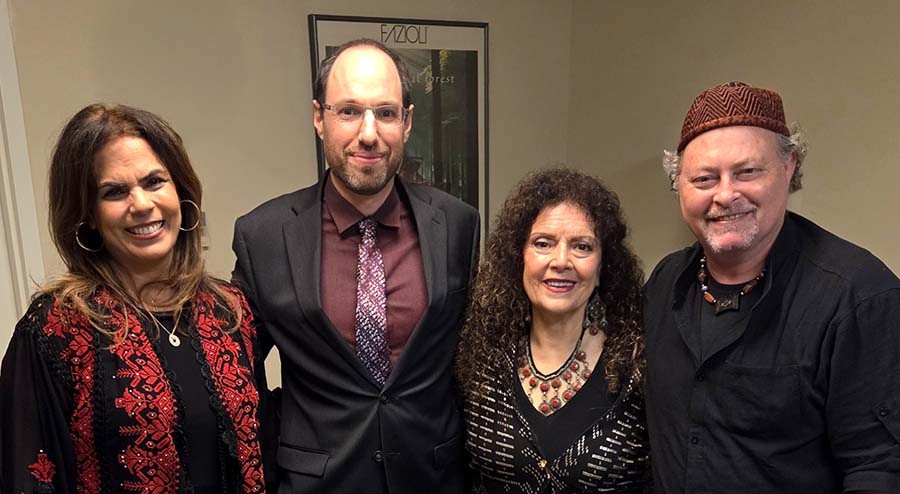
The simple but lovingly filmed part of the concert, “The Songs She Became,” opened with “Ave Mariam: The Sacred,” a wonderful presentation and stunning tribute to Mother Mary based on the Ave Maria by Vladimir Vavilov and made famous by Andrea Bocelli. This interpretation featured USUL’s trio, Raneem Barakat, mezzo soprano, Michael Snono, baritone and Abu-Khader, alto. They were accompanied by Majd Maary, electric bass, Zohreh Shahbazy, percussion, Helen Becqué, piano, and Sanaz Nakhjavani on the qanun, a Middle Eastern zither.
A tribute to motherhood
The performers on stage at SOU ended the concert with a group participation song, a tribute to motherhood with the audience singing the chorus, “Yamo, Yamo,” meaning: supreme mother of all beloveds. “You bore me in your womb for nine months / Endured so much pain to bring me to life.”
As always, the stage was adorned with stunning flower arrangements by DellaRovere, with purple irises, the national flower of Palestine. She once again punctuated the performances with a poem of elevation, reminding us we are part of the divine: “There is a place within us / smaller than a mustard seed / that is untouched and untouchable / uncorrupted and incorruptible.”
On Friday, Dec. 5, Abu-Khader presented a talk at the Methodist Church in Ashland, co-sponsored by Ashland Together and the Ashland Food Co-op, as guests munched on hummus offerings by chef Jackie Rosen.
Abu-Khader talked about the three things that shaped her life: Religion — various faith traditions in Jordan, Jerusalem and Palestine that inspired her music (all places she taught, studied or lived); gender — the incredible strength of Middle Eastern women and how they preserve tradition; and citizenship — how living in different regions added to her rich cultural heritage and influenced her life and her music.
Ashland resident Lucie K. Scheuer is a former copy editor and staff writer with the Los Angeles Times, where her work included features, reviews and a column on films in production. Email her at [email protected].